Yesterday morning, accompanied by Stephen and my son Matthew, I visited Josh’s garden to return a few trees that our club had displayed recently. Josh has been a bonsai artist for 30 years (rough guess but pretty accurate) and is one of the few out there that truly inspires me. When you talk about bonsai and techniques with him, his knowledge is evident, but he also tries to learn from you. Most bonsai artists of his level tend to close their mind to suggestions from people with less time served, but not Josh. A walk around his garden is always fun and ideas and suggestions are made by everyone with no one taking offence.
I had previously visited Josh’s garden in September last year and this is the page I put together for the Society website. Josh’s Garden.
I was looking forward to this visit as I knew all the deciduous trees in the ground would be bare allowing me to see the structure of the branches.
These are the first trees to greet you on arrival. A large formal Larch, not really a bonsai, but you definitely know you are at the right house 🙂 A massive Beech and a chunky Field Maple still to find a bonsai pot. I’m the black ninja hiding behind the Beech.
 Here’s a close up of the field maple. It was collected from park land during a club dig many years ago and chopped down and developed in the ground.

Stephen admiring my camera work in the background 🙂

Nebari

Other side
Josh talking about how he developed the Field Maple.

A few shots of the big Beech collected within a school grounds.

 This next one is a favourite of mine. Josh said he wasn’t sure what to do with it. Give it to me was my reply 😀 It’s a Wych Elm, Ulmus Glabra. Again, it was developed in the ground and has never been in a pot. I think I managed to get Josh talking about most of it’s history on video. I’ll be putting together a movie clip of the visit soon.


My son Matthew for scale
This is the next part of the garden you walk into. You step out of the back door into a display area and also where Josh does most of the work to his trees.

Stephen standing in admiration
Here’s a few of the trees in this part.

Shohin Lonicera


Hornbeam

Elm Raft

Cascade Ivy
When you turn around and look the other way, he has a Japanese Garden type display area with gravel, stones and water bowl.


Camellia Bud
Over looking this are a few more trees. These two are Raulli, similar to Hornbeam.
 Next you walk through a gate into the training area. This is where he developes most of his trees in open ground.
 This is a contorted Hazel with catkins hanging. A truly beautiful tree that may make it into a pot this year.


 This is an Oak that is fighting with the Hazel for the pot 🙂

This is a Japanese Maple that Josh is thread grafting. Here you can see the branch bent round and thread grafted through the hole drilled in the trunk.

 This is another thread graft on a Larch.
 When we arrived, Josh had been working on several Beech. He was digging them from the ground, trimming and adjusting the roots and putting them back in the ground again. This way he is maximising growth and improving the nabari. This obviously works when you see the nebari on his trees.
 Josh took us into his garage to show us a log collected from a downed Oak. He decided to turn it into a Mantle for his fireplace. I asked if he had ever tried woodwork before and he said no. I guess he can turn his hand to anything.


 As it was bloody freezing, we retired to the house to drink tea and talk about bonsai, movies, fishing, then bonsai again.
Why did I call this post ‘A different Approach’? I believe Josh’s approach to developing bonsai in the ground opens up more avenues to creating quality bonsai. It’s not necessarily a new way but I believe he has a different slant on it. He isn’t growing trunks, he developes complete trees in the ground before lifting. The Wych Elm is a fine example of this. I would have had it in a pot years ago!
Our club is going to do a day of garden visits this year and Josh is happy for us to come to his for a guided tour. Can’t wait 🙂


 Another tree that I liked was this Fraxinus Ornus, a type of weeping Ash I think. I loved the Uro’s.


 A beautiful flowering Quince has been trained up the wall of the Tea rooms.
 Here are some of the flowers and shapes that caught my eye.


 It’s a lot of filling out to do this year but it grows very fast. Phil has left it in my Tunnel for protection. I have very reasonable rent rates 🙂

 I managed to steal a wooden box from Stephen that looked as if it would fit. With a few minor adjustments, it did.
 Adjusting the angle.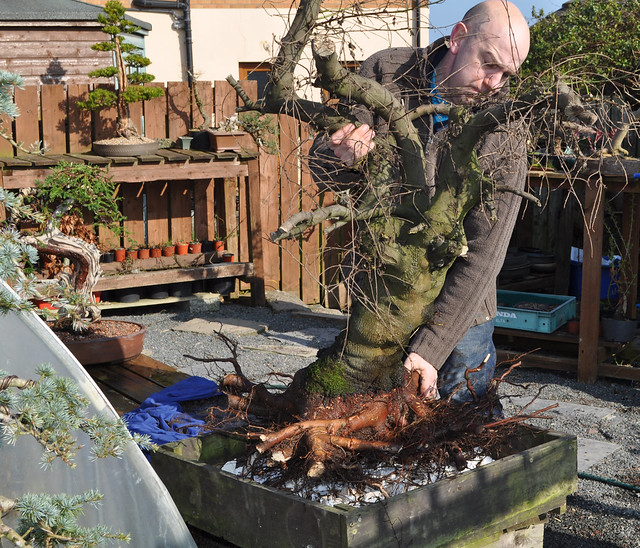
 I then removed all the die back caused by the freezing temperature over the Winter.
 A quick lift and then that moment when you wonder if it’ll fit through the door!
 Measured to perfection.
 Potting mix added once it was in place. I used a heavy grade of grit and cat litter [SP]
 Working it well down into the roots to avoid large air pockets.
 A good watering in to finish off.
 As this variety is new to me and, from all enquiries made around the world, pretty much new to bonsai, I’ll be interested to see if it survives.
 A quick scrape told me that more was alive than expected.
 Phil and I pull the tree out for a closer look at the roots.
 and it was at this point that I remembered that I screwed one of the root ends to the pot for stability.
 There was plenty of fine roots and I was able to remove a few problem roots.
 A quick check with the new pot and I was able to confirm that it would fit at the new angle.
 Potting mix was added. I used Grit, akadama, kyodama and Cat litter.
 The roots made it a little hard to tie in to the pot. I had to use a wooden block to support one of the roots.
 Mix added and ready for a good watering.
 After a good watering.
 A close up of the base. There’s a fantastic surface root to the right as well but is covered to keep some fine root covered until the tree settles.
 It’s now tucked away in the poly tunnel and I was able to lift it by myself 🙂


 I’ll keep you posted with how they respond to this light pruning 🙂
 and yesterday, rough looking but it has survived the Winter.
 I trenched around the tree having to contend with some roots from the big tree behind it.
 It had been moved to this spot about 4 years before and was therefore shallow rooted.
 Into the car.
 I’ll post more on this in a few days. It has a rather nice deadwood area. Fingers crossed it’ll survive the lift.
 Bonsai Eejit