Paul’s Virtual

Paul Bowerbank sent this altered virtual of the hawthorn in the previous post having removed the long branch to the right. I must admit I’m very tempted to do it right now 😀 It gets rid of a now very pronounced straight section.  However, I will leave all alterations for a while giving myself time to make a few decisions. I will build most of the structure within this tree by clip and grow, only wiring when I absolutely must. Wired branches on hawthorn stand out a mile when you see their artificial bends during the Winter.

Tale of Two Apices [Apexes]

This twin trunk raft Hawthorn of mine has been a great tree to play with and learn from in recent years. Its a vigorous tree but by it’s very nature has been a problem for me to come up with a convincing design. As you can see from the photo, the two apexes are very close to the same height and also the raft/root portion of the tree  is unconvincing as it rises out of the pot in places.

I discussed this tree with Peter Warren during a workshop last year and he suggested that the tree be tilted to the right to raise the left apex higher. This would also lower the other trunk line down to the soil surface closing the gap and make a more convincing design. I had already toyed with this idea during the previous repot but at that point it wasn’t possible due to the heavy root to the left. It would be raised out of the pot and would ruin the design. Peter said that this time around I might be able to reduce the root further back allowing for the change. This is the root in question.

This would be the new angle

I don’t have a suitable pot for the new position but I wanted to repot the tree and see if it was possible to carry out this alteration. If I was able to change the root now, I could pot the tree into a temporary training box and then keep an eye out for a suitable pot for a transfer next year.

When I took it out of the pot, it had done it’s usual thing, and had circled the pot with roots.

I removed all the long roots and had a close look at the problem heavy root. By working back step by step I was able to removed sufficient root to allow me to make the new angle. Here you can see how much was removed.
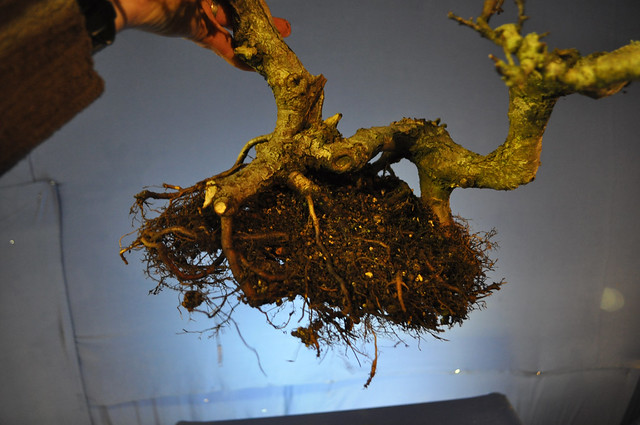
Happy to remove this heavy bit considering the strength of the tree.

This was what was circling the pot!

This is the tree potted in a training box at it’s new angle. See the change in the apex heights and also how much more convincing the surface roots are. I might tilt a little further yet but for now I’m happy until I can find a suitable pot.

I’m sure someone out there now is saying ‘Shell Pot’ 🙂 I’m not a lover of the shell but this might be nice. This is a virtual I made after PW ‘s visit. And this angle would definitely be achievable now.


That Pot

The pot that I swapped with Stephen a week ago has now found a new tenant. I really wanted to get a tree into it this year just so I could look at the pot on the benches 🙂 I survey of trees brought me to this root over rock Cotoneaster. It’s current matt brown pot isn’t lifting the tree in any way. I wanted something that would help show off the flowers, berries and amazing Autumn colour. This pot might not be ideal, but it close for me. The size was just slightly larger than the old pot and I was able to lean the tree slightly to the right to make the image more dynamic and bring the heavy root to the left more into play.

This was it in the Autumn, so you can see why I wanted to lift the colour of the pot to compliment the foliage.

and before potting

and after in the new pot at a new angle.


crataegus's avatarMichael Hagedorn

Many of you are deep in the thicket of repotting, which I know can be one of those puzzling puzzles. This is just a short post on what I think are some of the big ones to not forget:

1. Don’t have your tree TOO dry before repotting. Although a bit easier for us, we would have a dehydrated tree just before cutting off many of its feeder roots—which ends up as a lose-lose bargain. Better to have it too wet than too dry.

2. As a general rule, don’t bare-root your trees. That’s for specialists doing special work and try your best to ignore the Japanese magazines showing someone boldly bare-rooting a 100 year old pine, or some silly blog like Crataegus Bonsai showing hosing of a deciduous tree. Bare-rooting probably kills more things than all others combined, so without the attending techniques, I would say don’t do it unless…

View original post 307 more words

Ian B’s Kyiohime Maple Repot

This is Ian B’s little shohin Kyiohime maple after a repot. It was in dire need of repotting and the roots proved problematic. The pot Ian had purchased for this proved to be too risky to achieve in one step. This was my fault, not his, as I had picked the pot. It is now in this nice little blue one, a Lark Lane pot if anyone remembers them. I have a real soft spot for them.

Which do you prefer?

Following on from my last post, I thought it would be fun to try out a quick poll among you all to see which front you would pick for Stephen’s Hornbeam.

Here are your two options:

FRONT A No pruning wounds

FRONT B Showing two large pruning wounds

You decide!

Stephen’s Hornbeam Repot

Stephen asked if I’d give him a hand repotting his Hornbeam. It’s a big tree and he’s only a hobbit sized fellow. 🙂 I wanted a hand with my big pine as well, so we opted for a potting session on Saturday afternoon.

This is the hornbeam

It has an impressive buttress, but that has been part of the problem with this tree.

The heavy roots also translate into heavy roots underneath. The problem now is getting the tree into a more suitable pot. Any of the right depth are unsuitable as the tree sits solidly on a heavy wood base. Stephen attempted to pot this tree last year but the pot he picked was a non-starter as it was too shallow. This is the offending base root/s.

This time around we took our time and slowly removed some of the wood to allow it to fit a shallower pot. Stephen had purchased a Wallsall Ceramic pot for this back in the Autumn, and even though it was deeper than the previous new pot, the tree was still was too high when placed in the pot. By removing the wood as seen below we hoped that would be resolved.

Stephen prepares the new pot.

And this is the tree repotted. Now, what’s the best front?! This is the front I prefer. The root spread is impressive and all chop mark deadwood areas are hidden at the back.

This is the other side. Still really nice and some would say that the wounds are more like uro’s and are worth showing off. The nebari is probably slightly better from here as well. Which is your favourite?

This is back to my front and with some slight pruning towards the apex as the buds where too strong in this area.

Nebari

It was fun watching Stephen trying to get it back in the car 🙂

See it even fits in a hobbit car!!

futterwithtrees's avatarfutterwithtrees

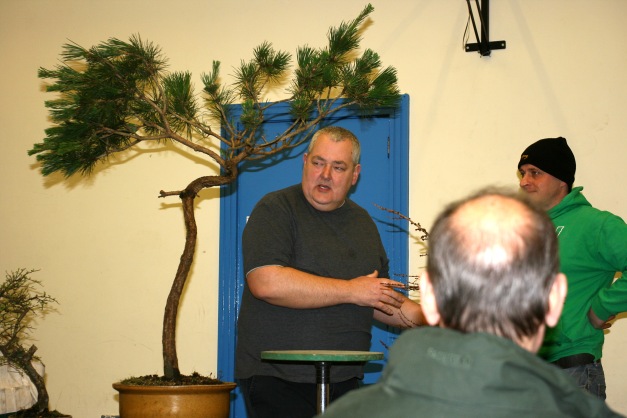
Last Friday night brought  another NIBS club night attended by Robert Porch who in his very relaxed style hosted the evening. He did a very basic styling demo on a few members trees and basically demonstrated what could be done on some raw material in a very short space of time and with a bit of thoughtful consideration.

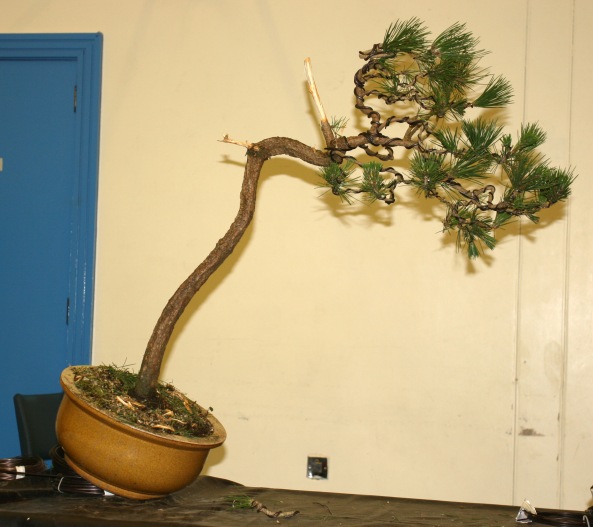
The first tree he worked on was a rather tall and slender Mugo Pine that had been grown from seed by a member over a
period of about 20 years.

Robert

The Raw Material

Genaral

Santa’s little helpers wiring the tree

Mugo Pine 1

On the way

Mugo pine

 The finished product

Stephen

A few members were bold enough to offer some suggestions re the design of some raw material and Robert very quickly enlisted their practical help. Here is Stephen AKA Bonsai Baker after he  had been press ganged into putting his suggestions into practice. It was one of…

View original post 82 more words

Soldanella Flowering

This little Soldanella, or Japanese Snowbell,  is flowering for me. Thanks to Robert Porch I now have a rapidly growing collection of these. I have just acquired a really small variety from him as well.