I took this Trident Maple to the club meeting last night and a few of the guys were good enough to defoliate it for me.
This afternoon I took a few minutes to go over the tree and remove extended growth and unwanted branches.


I took this Trident Maple to the club meeting last night and a few of the guys were good enough to defoliate it for me.
This afternoon I took a few minutes to go over the tree and remove extended growth and unwanted branches.
My root over rock Air Layer was checked today for roots. No sign as yet but it’s early days. As you can see, it’s growing vigorously below and above the layer. I took a few minutes to trim the extension growth below the layer. I left the growth on the layer itself to aid in the production of roots.

After trimming.

My Satsuki is nearing the end of it’s flowering period and will soon need to have all the flowers removed. I have already completed this task this year with my Rhododendron, this can be viewed on an older post.
Lee, who commented on that post, was asking for clarification on what I meant by removing the seed pod. Here is a step by step through the process.
Here’s a typical flower on my satsuki.It’s getting a but tatty looking and will soon fall.
 This only means that the flower petals will fall. Left behind is usually the ovary and the stigma. Below you can see the same flower bud with the petals removed and the other bits, also including the stamen, remaining.
 This is the part that must be removed to avoid the tree wasting energy in producing seed. This can be picked out with fingernails but it is best to remove with scissors as shown below by cutting through the pedicel or stock behind the pod.


This is the removed seed head. If you get it early, it is still small and a lighter colour.
 Below is a typical sight on my satsuki at the moment. The petal has fallen and the pod with style and stigma is all that remains. Notice it is bigger than the one above already and is a slightly darker colour. Energy is being wasted.
 Hope this helps explain the process. I’ll maybe add this as a permanent page on the blog somewhere for future reference.

The Cotoneaster that was collected a few weeks back is showing signs of life.
Small red buds can be seen in many places so fingers crossed.


Alas, the big Ceanothus that I lifted has now been checked and I can pronounce life extinct 😦 It was a long shot and had suffered during the cold snap this Winter. It did try to bud but these soon died. Ah well, nothing ventured, nothing gained!
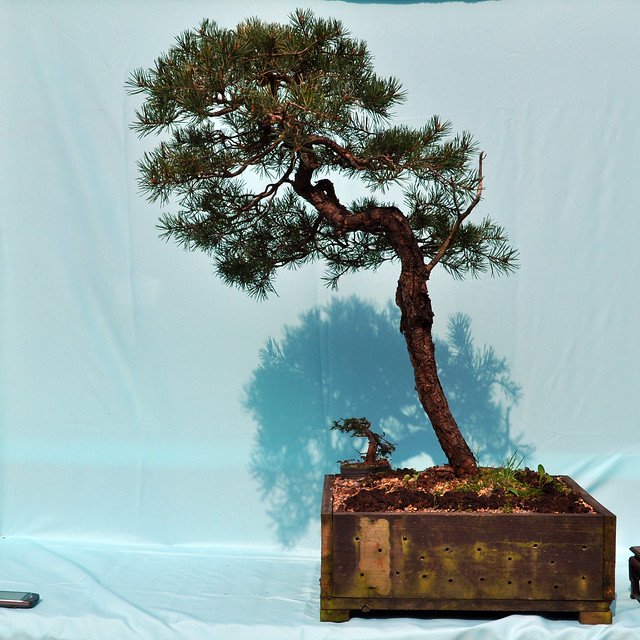
In 18 years of bonsai I had never came across needle cast on Pines. Am I just lucky? It’s strange how this hobby/art throws up new things every year. Just when you think you know something, you find out you know precious little!
This weekend I spent a good bit of my time researching and asking for advice on Pine needle Cast on Scots Pine. My pines are cast free but my friend Stephen has it on 4 of his. We believe it has spread to his garden on the wind from a large Scottie that was over looking his garden. The council cut it down as it was suffering from something. Now we know what that was!!
Here’s a few photos of one of Stephens infected Pines.

 As you can see, the old needles have turned brown and have the banding that indicates Needle Cast. The tree is still strong as can be seen by the new candles emerging.
This was the tree in April, it looks strong and there was no visible sign of Needle Cast.
So what do we do now? I googled it, as one does these days, and read about all these fungicides that work, Zineb being the main one. Then as I look further into it I find that this is no longer available under EU regulations. I then refine my search to needle cast on bonsai. You can bet if anyone knows how to mollycoddle a pine tree its a bonsai enthusiast. This thread on the Internet Bonsai Club Forum was useful. I found more references to Zineb but also mention of regular treatment with Murphys Copper Based Fungicide. This prevents the cast spreading to new needles and with a prolonged period of treatment you can eventually eradicate the cast. This can take years.
I phoned Stephen and told him to hit the Garden Centres to buy this product. Yep you guessed it, nowhere has it!! We are still looking. This product is going to be removed from the market in 2013 and Murphys are no longer making it. Our only hope of finding it is in some back water garden centre that still has old stock. So far, no joy.
During this process I had posted a request for information on the Wee Trees Bonsai Forum, and Molly, Mike, Corin and Paul, 4 of the members, offered advice. The best bit of info came from Molly who asked his bonsai mentor, Rob Atkinson for advice at a weekend workshop. Rob said that copper based fungicide was the best treatment and that if Murphys was unavailable to try Vitax Bordeaux Mixture. Also, remove all infected needles and get rid. Remove all needles from the soil surface and even remove the top layer of soil. Keep the tree on the dry side and only water the soil when watering. After a few seasons, things should start to return to normal.
Well Bordeaux Mixture, containing Tetra Copper was readily available and was swiftly purchased.
 So there you have it! The power of the internet and the bonsai community. I think at some point I’ll add this to a page on my blog as opposed to a post. At least it may help others who find themselves in this position. Thanks to all those who offered advice and even a willingness to post over a few packets of Murphy’s!
I took a notion to create a broom Style Cork Bark Elm. (Doesn’t he already have one!) Yes, I have one but I want one slightly bigger 🙂 I’m not exactly short of Cork Bark Elms see next pic, and I have one that I had styled but didn’t have great branch placement. I was going to chop the top but decided to air layer instead.
Some Corkies in the Tunnel.

This is the one selected for layering.

I removed a few branches and marked out the area to ring.


I used a sharp knife and cut top and bottom of the planned ring.

I removed the bark in between with side branch cutters.

It’s amazing just how thick the bark is one this variety.

Sphagnum moss is then applied arounf the ring and held in place with cling film.


To finish off I wrap a strip of pond liner around it to keep it dark to encourage roots. his can be removed to check for white roots inside the cling film.
 It’s back in the Poly Tunnel and has had a good soaking to ensure the moss is evenly damp. I’ll keep you posted. I think this should issue roots quite quickly.
This afternoon I did a few air layers. One to improve a tree, one to increase stock and one just for the hell of it to see if it works.
I started off on my root over rock Cotoneaster. The apex of the tree is contrived with a very obvious man made bend. I plan to bring up a lower branch to create a new apex and change the front slightly. As it’s an unusual variety of Cotoneaster I decided to layer off the apex to create a little Mame version. I may even put it on a rock too. Here’s the photos.

Tree before I started, slightly over grown.

Apex to be removed, a bit of an 'S' bend

Two branches removed to allow space for layer.

Bark stripped and ready for moss

Narrow roll of Cling Film used to hold moss in place

Layer in place

I then added a layer to a Crab Apple that I bought in a garden Centre sale for £5. I hope to get 3-4 off this one over the next few years. No photos of that one.
Finally I added a layer to an Oak that was field grown but is relatively poor material as it stands. I hope to do one this year and another next year, finally leaving the straight trunk with decent nebari. This will be planted in the ground and used to create a broom style tree. Here’s a few pics.


Today I fed my trees. Time for the neighbours to close their windows and bring the washing in 🙂
This is what I use.
 I use Green Dream for my better trees as it is nearly invisible on the pots. Results of this have been pleasing this year so far. This is the first year I used it.

The rest of the raw and semi styled material gets the Chicken Pellets. A bit smelly but cheap and effective. I’ve been using them for years now and when you have a lot of trees sitting about, this helps keep the price of feeding down.

I also use the Seaweed Extract as an in between feed, watering it onto the trees. I sometimes forget to do it but I’m making a conscious effort this year to get it right.
 I used a lot of Bio Gold on my better trees last year. This is the best stuff on the market but it way over priced in my opinion. Here’s hoping Green Dream is a dream.
Roy invited me up to his house today to give him a hand trimming and pruning back his trees. A few of his bonsai had become overgrown and had started to lose important ramification. He had asked my advice on this last week and I said it would be easier to show him.
Roy, by his own admission can be reluctant to prune hard on deciduous trees and I respected that today. In a few cases, if it were my own tree, I would have gone harder back, but I think we struck a nice balance between us. In fact once we got started, Roy was as heavy with the scissors as I was!! 🙂
First up was a Korean Hornbeam that he bought last year and was not in good health when he got it. I think the price reflected that. He potted it on for a few months to give it space at the end of last year and then did a proper repot during the early Spring. It’s his first one of this variety and he was unsure how far to prune it back. The growth was very long with leaves at the ends. The majority of this would have to go. This was the tree last week when I was up.
 The overall size is about what he is aiming for but the structure of the branches was very poor. I would have liked to have gone a little harder with the pruning to ensure it back buds in the right places but I feel as Roy gains experience with this variety he will be able to prune it back again later in the year after new growth appears. Here’s it after pruning.

 As you can see below, still plenty of longer branches that I would have liked to have cut back.

It needs to bud back on lower branches that have very poor secondary ramification but his good care will achieve this during the year.
Next on the table was his Deshojo Japanese Maple. This has become a little over grown, especially at the apex. This is it last week.

 We started to shorten in growth that hadn’t been pinched and removed branches with long inter-nodal length. Some of this was last years growth. Black Fly was visible but Roy had already sprayed. Some dead branches could be seen but these where mostly minor and probably occurred over the Winter. Not uncommon with Deshojo.
This is it after our work. As you can see the colour has faded in a week as the foliage matures.

 The tree is in good health and Roy has never defoliated it in all the years he’s had it. Perhaps later in the year this may be an option. This would allow for a better look at the structure and for further pruning and a little wiring to take place.
Next up is a Formal Upright Trident Maple. It has the same problems as the Hornbeam in that it has plenty of tip growth but a lot of die back of inner branches. This was it last week.
 As well as the die back, lower branches were starting to struggle and the branches at the apex were thickening rapidly. This was losing the whole balance of growth within the tree. I removed the dead bits and, starting at the apex, worked my way down thinning out the heavy bits and shortening the over all size of the canopy. This will allow for back budding and extra light to gain access to the interior of the tree.. This tree has great potential. Roy was really getting into the swing of things and didn’t need much encouragement to start removing branches. Here is the tree afterwards. I just love this John Pitt Pot 🙂
 After lunch we gave a light pruning to a few other trees. His two Hawthorns had some new growth shortened. This first one had no flowers open last week. It will need a major wiring session this Winter to sort out the growth but has great potential.

His other Hawthorn is just nearing the end of flowering.

 This Berberis got a light trim and also needs a full wiring this Winter. Yes, the pot is made of Granite!! This baby isn’t going to blow over any time soon!! 🙂


Next I trimmed back a Golden Larch group, Pseudolarix amabilis. A lot of dead branches at the bottom and over extended ones at the top. Here is the before and after pics.

 I would have liked to prune back hard here but I’ve don’t have a lot of time spent on this variety. It was also recently repotted so I erred on the side of caution.
This Trident Root Over Rock and Crab Apple also got a light trim. The Trident is crying out of a defoliation and full wiring. Roy’s going to be busy 🙂

 Last up is a tree that I’ve been gagging to cut back for a few years. It’s a big Chinese Elm. I left it to last so that Roy might start to believe in the method of my pruning. If he didn’t like it, I could always run away as I was finished 😀
This is it last week. You can just about see the trimming line from it’s last biggish hair cut about 2 inches into the canopy. I planned to go harder back than that.

 There was a serious amount of dead branches in the interior of the tree. No light was getting in there and die back was always going to happen. As it dropped all its leaves this Winter, light had penetrated the canopy and back budding had started. These would have been lost again as soon at the canopy filled out. I removed the dead bits and started into the long over grown branches. I think Roy was initially shocked but could see the merit of the work. Before long he was as bad as me. He had to be, it was too late 🙂
Here’s the tree afterwards. Compare the size of the pot to the canopy in both photos to get an idea of how much was removed 🙂
 He was happy with the job done and even allowed me to photograph all the trees at the end. Here are a few other shots taken during the 5 hours of work.

Roy trying out my camera.


The mess left on the grass after pruning.

 I would like to thank Roy for letting me hack away at his trees. It was probably nerve racking at certain parts 🙂 It was Hard for me too when I wanted to go even further, but I think we hit the right balance to keep us both happy. They are his trees after all. My biggest achievement of the day was not using a single bit of wire, I’ll leave that to Roy 😀
Not only am I not drawn to them, I hate the little buggers!! 🙂
Ian B was part of last nights royal pruning session. I had been caring for his big Chinese Elm and brought it out for a chat about how I had brought it back to life (CPR & jump leads 🙂 ) When we started examining the new flush of buds we found the biggest Scale Insects I had ever seen!! These where sorted today with a nice spray of insecticide. Before I did this I took a few photos in case anyone hadn’t seen them before. Nothing else seems to have them. I guess they grew super sized in the heat of the tunnel.
Here’s a few of them and you can also see the sticky white stuff they produce.


 and evidence of the new buds.


Shop for quality bonsai
bonsai and garden
The Kaizen Bonsai Blog
Teaching, Learning, Enjoying Bonsai
The ramblings of an old artist and someone who would like to grow better bonsais trees
my bonsai
My wood creations
Hand Crafted Furniture
Creativity Through Bonsai
dirt leaves flowers
bonsaï | vidéo | Japon - ActuBonsaï
Japan's aesthetic, craftsmanship and spirit
Bonsai with a hint of madness...
"Tibolar-RS. your soil needs it, your plants will love it"
 Bonsai Eejit