
Now that I’ve shared photos of the Willowbog Collection, I’ll move on to some photos taken on the Saturday during a workshop with Peter Warren.
As a spectator, I was able to float about and get some nice shots of the action. Here’s the day in pictures.
Peter talking to yet another Peter about the options on his raw material Larch. At least this Peter wasn’t wearing crocs, an abnormality on the weekend 🙂

 Dave gets to work on his yamadori Common Juniper cascade. Don’t adjust your screens, he really was that tanned!!

Mr Snart surveys the tree in question.


Janice talks to Peter about her little juniper seeking advice.

 Roberts workshop tree, a little Chinese Juniper.
 Thinning out before Robert gets wiring.

 Further discussions about Peters Larch.
 Steve gets stuck into a little Larch, one of several trees brought along for tweaking.


 Everyone gets to work.


My favourite workshop photo of the weekend. Willowbog head buck cat watches proceedings 🙂


 Alan, a local artist, took a quick sketch of Peter working on Dave’s Juniper. Note his great portrayal of the crocs 😉
 Work finished for now on the Common Juniper. This tree was in amazing health as all Dave’s trees seem to be. The growth at the apex has been refined but extension growth at the cascading tip has been left long to allow branches to thicken.

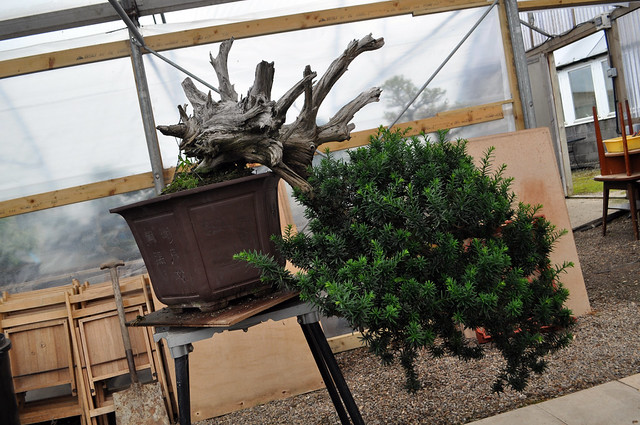
 This beautiful cascade with unusual deadwood reminded me of a juniper I had seen in a book or magazine a few years back. Peter Snart was able to show me a photo of it that evening. Of course I can’t now remember who owned it. Was it a Dutch of Belgian guy?
Final tweaking on Robert little Shohin Juniper.


 A busy day with a lot of trees receiving different work to suit to the needs of the tree and the owner. Peter is quick to pass on advice on the future care and techniques required for each tree to allow it to reach it’s maximum potential. I was interested to see that he wanted each participant to get what they needed from each tree, not what he, as teacher, could have imposed. A different approach to others that I’ve seen. It certainly makes the participants more involved with the design. In some cases options were left on trees to allow the individual to make a decision in their own time.

 Ulmus Glabra
 Pinus Mugo.

 Ulmus Glabra Raft

 Beech Raft
 Pinus Sylvestris


 And finally the man himself, Peter sitting on his ‘Captain T. Kirk’ chair. One thing I did notice over the weekend, Bonsai Artists called Peter tend to wear Crocs!!

 Japanese Maple

 Siberian Elm, originally an air layer.
 Japanese White Beech, I think!
 Pinus Sylvestris


 Part 3 to follow……


 Larch Raft


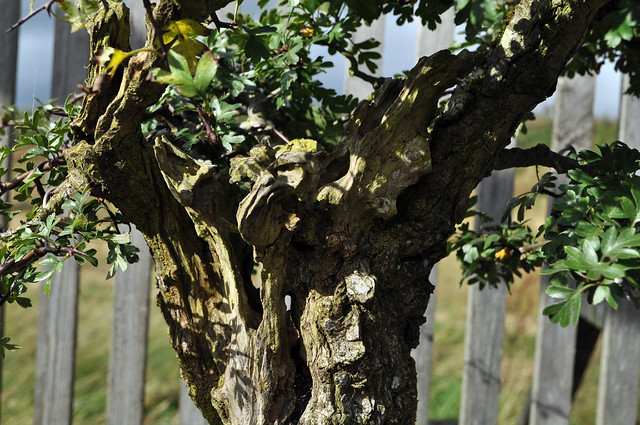
 Hawthorn
 Maple Clump

 Hemlock

 Part 2 coming soon.




 This is probably closer to the final potting angle.
 I know it doesn’t look like it, but there is some pretty good movement in the trunk line of this tree.
  This was it after removing the unwanted branches. I left the low branch on, I think this might make a nice feature.
 This is the stump for carving. By the feel of the pot and how steady the tree is, I think there is sufficient roots for this work to be carried out during the Winter.
 Considering I was going to just chop this off and bin it, I’m glad I waited for an Air Layer. I have another big Hawthorn that I now plan to layer next Spring.


 Most of the branches produced this year are now too thick and stiff to position with wire into a desirable shape. Others are in the wrong place. These, for example, are growing from the inside of a bend.
 I quite liked this as a possible new front.
 I removed the unwanted branches and left those that can still be of use in the design of the tree next year. The area where the air layer had been removed will need carving. It takes away from what is actually nice movement in the tree. Also, some deadwood at the base where old roots had been torn at some point in the trees past.

 Now that the tree has become better established in it’s new pot, next year I will direct any new shoots early while they are still flexible. I hope to see plenty of adventurous buds appearing in the Spring.
 Bonsai Eejit