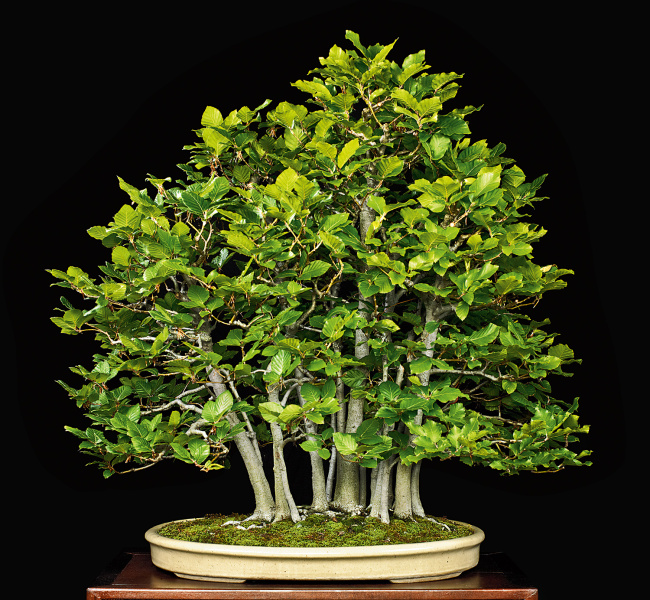
Creating A Beech Forest Bonsai

William N. Valavanis's avatarValavanis Bonsai Blog

Image

Beech are highly prized for bonsai because of their characteristic white bark, beautiful foliage, winter hardiness and easy training. There are several beech species native to Japan. The Japanese beech, Fagus crenata is the most commonly trained species for bonsai in Japan. Specimens near Mt. Fuji are especially valued because of their small thick foliage. The American beech, Fagus grandifolia, has rather large thin foliage and often collected specimens are grown for bonsai. The European beech, Fagus sylvatica, is trained for bonsai in Europe and spectacular bonsai are created from thick trunked collected trees.

In the United States European beech, and its numerous cultivars are commonly used in the landscape for different colored foliage or unusual growth patterns. These cultivars are usually grafted onto seedlings of European beech, so they are a widely grown nursery stock.

The normal leaf size of European beech is a bit larger than Japanese beech…

View original post 1,640 more words

Image

2nd Magical Bonsai Accent Exhibition

If you Build it, They will Come!

Further developments for bonsai in Ireland, all good news 🙂

See here for details

……………………………….

Soldanella Alba

My only white one but it’s flowering 🙂

DSC_0676

Echizen Hosui 2, or, The Difference Between a Copy, and Homage, and a Forgery

japanesepots's avatarJapanese Bonsai Pots Blog

Today we’ll take a second look at the work of Echizen Hosui, and take a look at the subtle difference between a Copy, a Forgery, and an Homage. For our first look at Hosui, you can look back here:
Echizen Hosui
Echizen Hosui was born Zenzo Yoshida in Fukui prefecture in 1936, and began making bonsai containers in 1974. It’s quite clear from his work that idolizes many of the greatest artists of Bonsai pottery, including Tofukuji, Yusen, and Aiso. Today we’re going to take a look at some containers that are marked as Hosui, and some that were made by Hosui, but marked as the work of Tofukuji. I don’t think these containers were meant to be forgeries, as enough clues were left for the discerning eye to distinguish them as copies. However, every pottery collector should be aware that such copies exist, and be able to distinguish between…

View original post 711 more words

Spanish Blog

It’s been a while since I shared another blog with you and I found this one yesterday.

Chian Bonsai

A great active blog showing some nice tree progressions. Even better, he follows me 🙂

Pay him a visit and give him a few hits.

Video

Latest from You Know Who…


Image

Mukdenia Rossi

DSC_0679