
Over the years I have mostly used Lime Sulphur to preserve any deadwood on my trees. Last year I decided to try a few different products. I had a few reasons for changing. Firstly, I find that Lime Sulphur doesn’t do that great a job of actually preserving the wood. Secondly, it tends to be far too white and unsuitable for deciduous trees. Thirdly, I’m finding it harder and harder to get my hands on Lime Sulphur, other than little 100ml bottles that cost far too much, and sometimes of dubious quality.
My main option to actually stop wood rot was to use Ronseal Wet Rot Wood Hardener (It Does exactly what it says on the tin 🙂 ) I can get this at any hardware store and 500ml costs £8.00. I have found this very effective in preserving my trees. Basically you are adding a clear liquid onto the wood which soaks in and hardens like plastic. The main drawback is that it leaves a slight shine that does wear off after a while. Someone somewhere said you can take the shine off with acetone. I haven’t tried this. The image below can be clicked on to view the product info.
 Whilst ordering a few things from Kaizen Bonsai I spotted a few other products that were being sold specifically for preserving deadwood on bonsai. I ordered a bottle of each for some experimentation. First up was this product.

Natural Bonsai Deadwood Preserver selling at £3.75 for 100ml. I used it about 3 months ago on a Cotoneaster that has a lot of deadwood. Up until now it’s been Lime Sulphur only on this tree and I find it far to white for the image. I added this product and the first thing that struck me was the smell! It honks!! It says to apply the product onto dry wood and let it soak in for a few days before getting it wet. It soaked into the wood very quickly. It stayed in my garage for 2 days and was every bit as smelly by the third day. I placed the tree back into the polytunnel where it been getting some protection form the snow etc and to this day, every time I open the door, I smell it! I would not like to display this tree indoors at a show this year in fear of stinking the room out. I have my doubts about the preserving qualities as well.
The next product from Kaizen is Tree Gum. It’s a 170ml bottle costing £6.95. I liked what I read on the site.
“Exclusive to Kaizen Bonsai, this liquid tree resin penetrates deep into old dry deadwood where it replaces the natural oils and resins that have been lost through weathering. Made using a pure natural tree resin, this is natures own way of preserving wood. Apply to dry weathered wood that is already coloured to your satisfaction. Tree Gum will penetrate extremely quickly deep into the wood. Once fully dry the natural underlying colour will return.”

I have used this on a few smaller trees to get a feel for it. It penetrates the wood well, has no smell and dries clear with no shine. I must say that I like the look of this one and plan to use it further this year. I doubt it hardens like the Ronseal product, but it’s natural and causes no harm to the tree or me 🙂
My next step was to experiment with using more than one product on the same tree to see how the react to each other. I used the Ronseal on my Escallonia followed by Lime Sulphur. The Lime Sulphur covered it no problem and also removed the shine 🙂


 Below is Ronseal freshly applied on top of Lime Sulphur on a Juniper. You can see where rot had started to kick in right at the base of the tree. I’ll add another coat of LS to finish it off.

 Last up is a Maple with a rotted base. I bought this tree last year, taking a risk on the health. I uncovered even more of the trunk showing a natural shari. Not ideal on a maple but I plan to make a feature of it. This is being treated with Tree Gum.
 If you are using anything different, I’d love to hear about it.


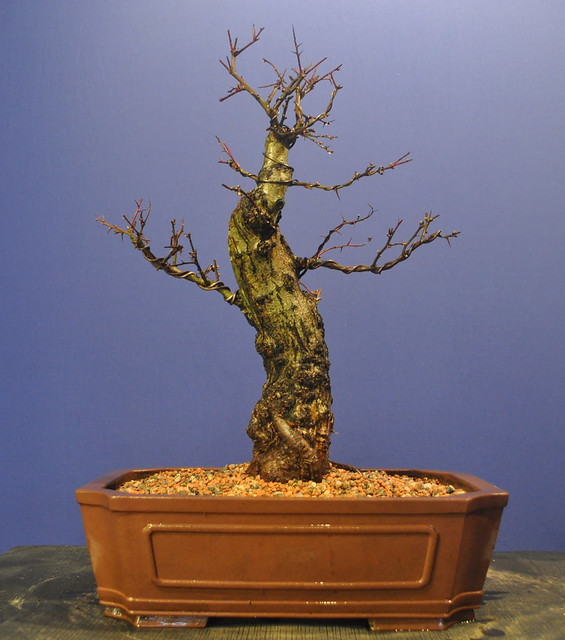

 This is a field grown Hornbeam. No styling done yet, just branch selection and pruning.
 Bark close up. Not bad for an 8 year old tree 🙂
 Last up is a Wild Pear grown from a cutting and field grown. It’s a chop down that I plan to create a natural broom style from over the years.
 Tomorrow I tidy up the garage in anticipation of a club event next weekend.
 This is it when I got it home.
 I shortened in the green areas as much as possible to encourage back budding. Extra light will be able to penetrate the inner branches. I was able to make a few decisions and remove a few unnecessary branches. I left two main branches both giving leader options to the front and back of the tree. The garden soil was think and totally unsuitable for container growing. The only way to remove it properly was to hose it out. This is the root ball. Quite healthy.
 I potted the tree up in an open mix of grit and cat litter (scp). This is one possible front. Deadwood is going to be a major part of the final image, in keeping with popular juniper style.


 I also spotted this really old berberis in another flower bed. Very straight but with a chop and a decent nebari, it might be worth a closer look.

 Last up is this monster Ceanothus. Not commonly used for bonsai that I can see, but I thought I would give this one a go as an experiment. It was cut back in Summer 2010 but suffered badly this Winter with all leaves dying in the cold. It’s not a hardy shrub. I’ve seen gardens full of dead ones after the last two Winters here. This one, even with dead leaves has survived. All branches underneath are green. There is some amazing deadwood on this that has suffered from rot. I feel that if I am going to do anything with this tree , I’ll have to lift it this Spring. If these Winters keep up, It’ll need Winter protection every year. Here are a few photos, some taken last year in Summer and the rest today.


 It’s my copy of Harry Harrington’s new Bonsai Book, ‘Bonsai Inspirations’.
 I have hundreds of bonsai books and magazines in my collection and was doubtful if adding another was required. Having known Harry from the old IBC years ago and being a lover and user of his website

 This proved to be a wise move. It is like no other bonsai book in my collection and shows Harry’s trees progressing over the last 10+ years. Chapters on developing and creating bonsai from Yamadori, garden plants, and semi established bonsai are very well thought out and the use of hundreds of colour photographs makes this a beautiful book to read. Well worth the money. Order your copy here.


 Bonsai Eejit